
OUR logo

YUMMY logo
Monday, October 11, 2010

Sunday, October 10, 2010
bakit nandito mga podcast nila sa blog nmin ??
kasi kaya po nandito sa blog nmin ung mga podcast nila kasi hindi nila mabuksan ung mga blog nila
-- tonet :)
-- tonet :)
Saturday, October 9, 2010


Friday, October 8, 2010
alejandro meaning
Spiritual Transformation
The most prevalent theme in the song is rejection. The introduction of the song establishes this concept right away:
“I know that we are young.
And I know you may love me.
But I just can’t be with you like this anymore,
Alejandro.”

The video starts with a funeral procession. Gaga wears a black veil and holds the Sacred Heart, the bleeding heart of God for humanity. Something is dead inside of Gaga and it seems to be her love for Alejandro.
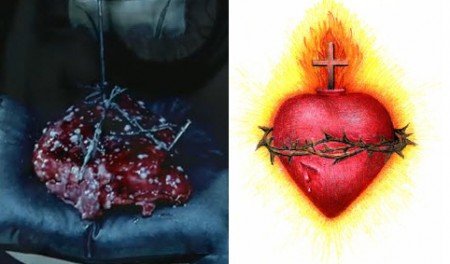
- Is there a syringe in the Sacred Heart?
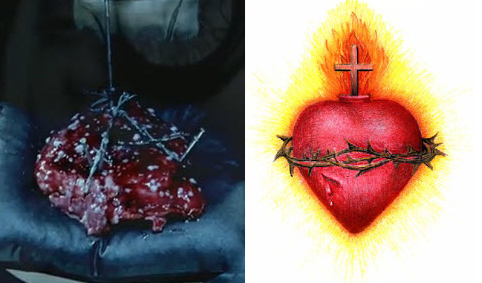
But who is Alejandro? A gay guy she cannot be with? A man she is cheating on with Roberto and Fernando? All possibilities, the song is not quite clear about that. The imagery of the video, however, tells the viewers that Alejandro might stand for something deeper.
In a later scene, Gaga is shown laying down, wearing a red latex nun suit and holding a rosary.

Looking at the sky she says: “Stop, please, just let me go.” Then, just when she says “Alejandro,” she raises her hands to the sky. In this context, it is safe to say that Alejandro might very well be God.
“She hides true love
En su bolsillo.
She’s got a halo ’round her finger,
Around you.”
The halo around the finger is a wedding ring and Alejandro has a halo around him, which signifies he is considered “holy.” The wedding ring represents Gaga’s union with God through religion, but she is now ashamed of this marriage. She hides the ring in her bolsillo, the Spanish word for pocket. Why does she refer to a Fernando and a Roberto at some point? Is she referring to the triple aspect of God, the holy Trinity?
The concept of rejection is thus applied to God as he does not seem to satisfy Gaga’s spiritual needs. She then decides to seek godhood herself by embracing a new type of spirituality. It seems to me the nun becomes a Luciferian priestess.
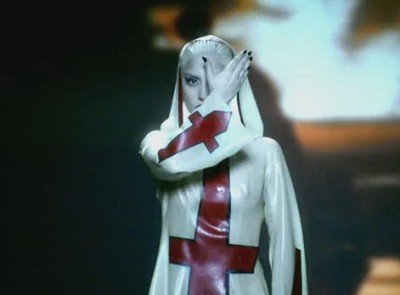
- Luciferian priestess hiding one eye as a sign of Illuminati control or loyalty
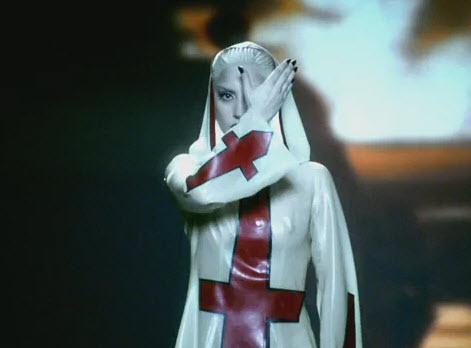
Inverted Cross
Gaga’s robe contains many inverted crosses. This is extremely significant in symbolic language. The cross is a symbol of the Christian faith as it represents Jesus Christ’s sacrifice and resurrection. In Christianity, the inverted cross is known as the “Cross of St. Peter”, in honor of Simon Peter who requested to be crucified upside down because he felt unworthy to be put to death in the same matter as Christ.
In non-Christian circles, however, the inversion of the cross represents the perversion and desecration of what it symbolizes. For this reason, inverted symbols are found in black magic and satanism.
“In symbolism, an inverted figure always signifies a perverted power (…) Black magic is not a fundamental art; it is the misuse of an art. Therefore it has no symbols of its own. It merely takes the emblematic figures of white magic, and by inverting and reversing them signifies that it is left-handed.”
- Manly P. Hall, Secret Teachings of All Ages

- Inverted cross and inverted pentagram as satanic symbols


The inverted cross, placed on Gaga’s crotch, becomes a phallic symbol. Superimposed and combined with her female genitals, the theme of androgyny becomes prevalent. In occult circles, the alchemical transformation of the spiritual matter, the Great Work, must unite both opposing energies.
Becoming a God

The rosary is a set of beads used in Catholic tradition for prayer and meditation. By swallowing the rosary, Gaga incorporates within her a symbol of religious devotion because 1) it is shocking and would get media attention 2) represents Gaga seeking to obtain godhood by her own means. We have here a symbolic representation of the tenets of Luciferianism, which is the drive to attain divinity by one own means. Lucifer is considered to be the active principle towards godhood, the one who brought “divine light” to the humans.

In another scene, Gaga is shown giving the sign of benediction and blessing, a gesture reserved in Catholicism to those who are considered Holy.

- A classic image of Christ showing the sign of Benediction and pointing towards the Sacred Heart
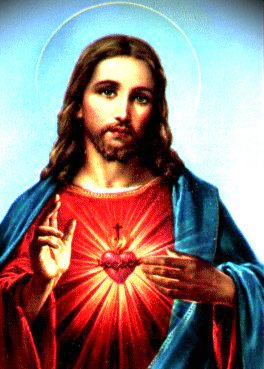
Later in the video, Gaga is violently pushed around and abused by the dancers surrounding her. She surrenders and removes her robe for sexual, ritual initiation.

At the ending of the video, Gaga is consumed from within and her “inner light” comes out, representing her transformation from the physical to the spiritual plane.
Gaga’s performance at American Idol truly exploited the Luciferian theme of the song.
Police State Imagery
Gaga’s spiritual transformation is taking place in a dark, oppressive and militaristic backdrop. This trend in music videos has been discussed in The Transhumanist and Police State Agenda in Pop Music. The article describes how the public is currently being bombarded with militaristic and oppressive imagery, intertwined with sexuality, in order to desensitize the public and create a subconscious positive association. Alejandro is clearly a continuation of this agenda set by the rest of the industry. During the entire video, we see in the background a giant screen displaying scenes of social unrest, buildings on fire and military police running around, placing the viewers in a tense and oppressive ambiance.
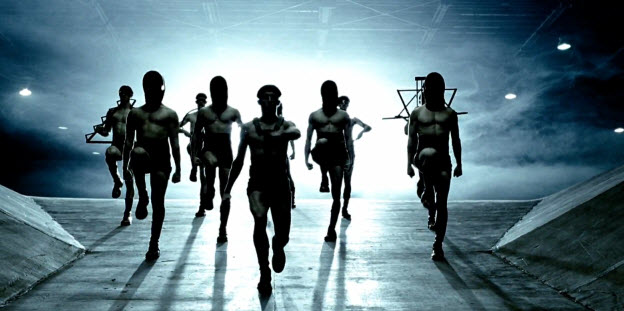
The video opens with men marching to a militaristic rhythm, some of them having their heads covered, maybe hinting that those men are prisoners of some sort. One of men is inside a pyramidal shape while another holds a hexagram as the prisoners march. Is this a representation of the masses marching to the rhythm of the elite, holding up high the symbols of its own oppression?
Gaga is then shown in a position of power, wearing a black, illuminated crown while looking over the prisoners performing for her.

The “Black Queen” removes one goggle at a time, flashing the Illuminati All-Seeing Eye sign (discussed in many previous articles on this site) and revealing the true nature of her power.
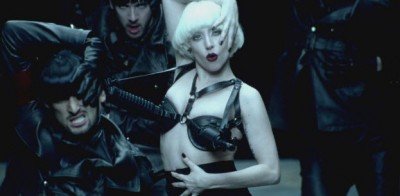
- Again, One-Eye hinting to the nature of the oppressive force
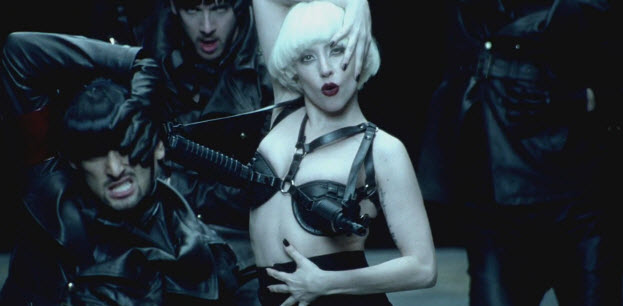
In this scene, Gaga wears a “gun bra,” in accordance with the agenda of the sexualization of oppressive imagery. Her back-up dancers are dressed in uniforms reminiscent of dictatorships of the era of Hitler, Stalin, Franco and Mussolini. Political oppression is indeed sexy … oh wait, no, it’s not … it actually goes against everything America supposedly stands for.
Mind Controlled Slaves?
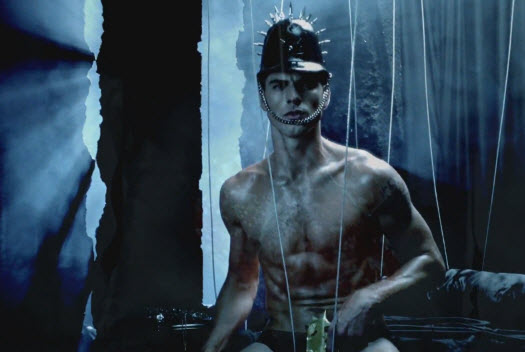
In a symbolic scene, a soldier is shown attached to strings, like marionette. He is not in control of his own movements and holds a gun on his privates (more sexualization of weaponry). He stares blankly, looking confused as a mind-control slave would.
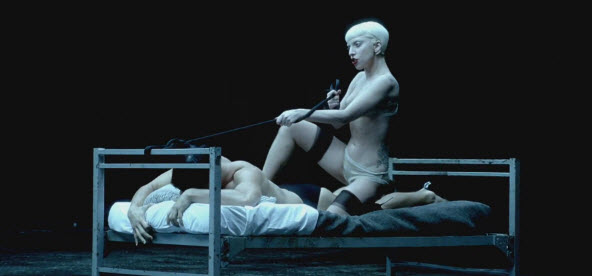
In what looks like an internment camp, Gaga has the gay men bound to a bed as she rapes them, in what looks like a reenactment of ritual abuse.
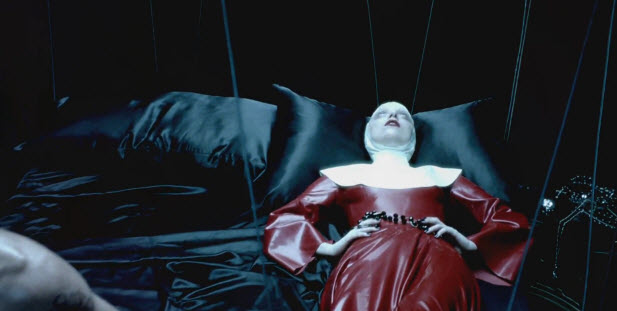
In the final scene of the video, Gaga is shown attached to strings. Is she herself controlled into perpetuating this agenda?
As stated above, the video to Alejandro is very complex and symbolic, and lends itself to multiple interpretations, depending on the viewer’s knowledge and point of view. There are, however, parts of the video in which the symbolism is clear and concise, leaving little doubt regarding the message being communicated. During the video, Gaga goes through a very profound metamorphosis, rejecting Christian faith by desecrating its symbols and embracing a new type of spirituality. Is Gaga’s transformation a representation of the transformation that is currently happening on a worldwide scale? Are members of the elite, who were thought to be part of “regular” religions, revealing their true, Luciferian selves to the public? Will the New World Order leave traditional religions in the dust to embrace a new type of spirituality? Whatever the case may be, pivotal videos such as this one disseminate into the collective unconscious a specific set of symbols and values that will become, in time, “part of our culture.” In order to achieve this, charismatic figures that are admired by the public are used make those messages cool and trendy. Music fans have been subjected to an intense creative drought in the past years, which caused them to be desperate for a new, eccentric and iconic presence. So Lady Gaga comes into the picture, slightly distances herself from the painfully formulaic music acts and is heralded as the new pop princess. She also brings with her all of the Illuminati agenda and flashes in her fans faces the symbols of their own oppression. I’m sure many fans have a gut feeling that something is wrong with her act, but still can’t stop listening to her. They must tell themselves, “well, there is nothing else to listen to.” And that’s what media monopolies are all about. -REFERENCE www.vigilantcitizen .com -BY mar♥In Conclusion
Related Reading
 Secret Teachings of All Ages by Manly P. Hall
Thursday, October 7, 2010


Wednesday, October 6, 2010
did you know ???
Mahogany Tree Plantation
The name mahogany is used when referring to numerous varieties of dark-coloured hardwood. Mahogany has a generally straight grain and is usually free of voids and pockets. It has a reddish-brown color, which darkens over time, and displays a reddish sheen when polished. It has excellent workability, and is very durable. Historically, the tree's girth allowed for wide boards from traditional mahogany species. These properties make it a favourable wood for crafting cabinets and furniture. Philippine mahogany, aka lauan, is the common name for a wood yielded by some species of the genus Shorea, or perhaps more accurately the name for a group of woods. These are medium density woods, with rather favorable properties, but they are not a mahogany, nor are they comparable in quality. It is not necessarily imported from the Philippines, nor is it limited to species which occur in the Philippines.
The US name of lauan is derived from a Philippine name, which refers to dipterocarp timbers in general. The import into the US is properly known as "red lauan", but the adjective tends to be dropped. The name lauan is sometimes also used for plywood, although strictly speaking this tends to consist of a mixture of woods of any species from the same general area. Such plywood is more properly known as Mixed Hardwood Ply.
In the Pampanga Agricultural College, they have also Mahogany Tree Plantation. It was established by their forestry and agriculture students during 1993. September 11, 2010 the Provincial Government of Pampanga led the tree planting of some 10,000 mahogany trees in Barangay San Juan Bano, this town over the weekend. The activity was done in cooperation with the Pampanga Chamber of Commerce and Industry (PamCham) and the Philippine Army's 703rd Infantry Brigade. This plantation can help to manage the microclimate in Pampanga.
BAMBOO PLANTATION
Bamboo, used to be called the poor mans’ lumber, is considered today by many bamboo enthusiasts as the “green gold.” It is growing especially in the developed world because the giant grass is now being known as a green product for being cultivated in several countries in Asia and therefore, renewable.One remarkable competitive advantage of bamboo over other construction materials is its astounding reproduction rate. By the way, bamboo with an estimated 1,200 species worldwide is a grass not a tree. Many do not know that some species of bamboo can grow up to 3.3 feet a day. In fact, some varieties of bamboo reach heights of more than 100 feet. (Manila Bulletin- June 18, 2010).
Our FRM 100 class conduct an educational field trip last September 11, 2010 at the Pampanga Agricultural College (PAC). It was stated that the said college and the provincial leaders and representatives of the private sector created the first Pampanga Bamboo Development Council (PBDC) in order to address the need to propagate, promote and develop the national bamboo program. The objective to the said council is to advocate for a sustainable environment and livelihood in Pampanga throughout the development and propagation of bamboo as a source of food and commercial products. Here in the Philippines we are still using bamboo basically for craft items and unbelievably the once considered poor man’s timber has been transformed into super strong and durable construction materials as: Flooring (tiles); structural components (like beams, posts and frames); boards (sawali boards) and even architectural and anterior material (like jambs, paneling and laminate).
This project will serves not just as a catalyst for global warming and its vegetation help absorb carbon dioxide, but it will also provide livelihood to Kapamapangans like the production of furniture, crops and paper and even helps the environment against deforestation, erosion and flooding.
JATHROPA PLANTATION
Did you know that Jathropa can give us biodiesel?
Jatropha oil is vegetable oil produced from the seeds of the Jatropha curcas, a plant that can grow in marginal lands and common lands. When jatropha seeds are crushed, the resulting jatropha oil can be processed to produce a high-quality biodiesel that can be used in a standard diesel car, while the residue can also be processed and used as biomass feedstock to power electricity plants or used as fertilizer it contains nitrogen, phosphorus and potassium. The plant may yield more than four times as much fuel per hectare as soybean, and more than ten times that of corn. A hectare of jatropha has been claimed to produce 1,892 litres of fuel. However, as it has not yet been domesticated or improved by plant breeders, yields are variable.
Myanmar is also actively pursuing the use of jatropha oil. On 15 December 2005, head of state, Senior General Than Shwe, said “the States and Divisions concerned are to put 50,000 acres (200 km²) under the physic nut plants [Jatropha] each within three years totalling 700,000 acres (2,800 km²) during the period”. On the occasion of Myanmar’s Peasant Day 2006, Chairman of the State Peace and Development Council Snr Gen Than Shwe described in his a message that “For energy sector which is an essential role in transforming industrial agriculture system, the Government is encouraging for cultivation of physic nut plants nationwide and the technical know how that can refine physic nuts to biodiesel has also identified.” He would like to urge peasants to cultivate physic nut plants on a commercial scale with major aims for emergence of industrial agriculture system, for fulfilling rural electricity supply and energy needs, for supporting rural areas development and import substitute economy.
Now in the philippines we also have Jathropa plantation for producing biodiesel. Last September 11, 2010 the class of FRM 100 (Introduction to Forest Resources Management), we held our fieldtrip at Pampanga Agricultural College. On the overview of Mt.Arayat we saw their Jathropa plantation. This plantation was the project of CHED. And Mr. Darwin Cotaan, our speaker discussed about the importance of Jathropa in the Philippines and how they develop the plantation. The location was suited for planting Jathropa because it grow on marginal and common lands. This plantation is very helpful in the Philippines because we’re always experiencing oil price hike and shortage of fuel products. I hope this kind of project will be much bigger and larger in the whole Philippines.
--- tonet berces <3>
Tuesday, October 5, 2010
Saturday, October 2, 2010
The sweetest suicide
Two years ago, a boy fell in love with a girl and the girl felt the same with the boy. Everything seems to be perfect for the boy, but the girl is not contented sometimes. One day the girl said to the boy "let's stop this, cause I don't love you anymore". The boy doesn't want to lose her, that's why he decided to be her no. 2 , even the girl loves somebody else. To be continued...
Subscribe to:
Comments (Atom)